Fresh Cheese in About an Hour, with Three Ingredients
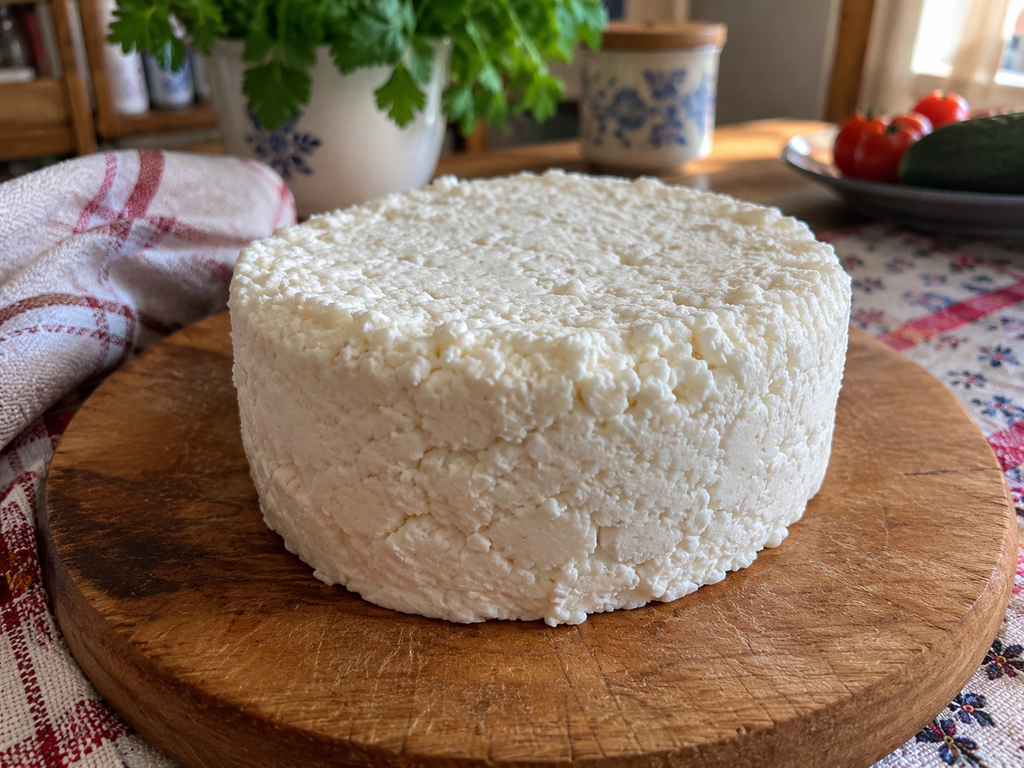
Homemade farmer’s cheese is one of the easiest things you can make in a kitchen. All you need is milk, lemon juice or vinegar, and a little salt. Hot milk is curdled with acid, the curds are drained in cheesecloth, and a short press turns them into a soft, mild, creamy fresh cheese that tastes much cleaner and fresher than most store-bought versions.
There is no special equipment, no rennet and no culture. You can make it soft and crumbly for spreading, or press it longer until it is firm enough to slice and fry. It is a good starting point if you have always wanted to try cheesemaking.
Quick facts
- Active time: about 30 minutes
- Pressing time: 30 to 60 minutes
- Makes: about 300 to 400 g (11 to 14 oz) of cheese, depending on the milk and how long you press it
- Difficulty: Easy
- Ingredients: milk, acid, salt
Ingredient and Equipment Notes
Milk. Use whole (full-fat) milk for the best flavor and yield. The milk should not be UHT or “ultra-pasteurized”, because the heat treatment can stop it from curdling properly. Fresh pasteurized milk from the dairy section works well. Fresh farm milk also works and gives excellent flavor, and bringing it to a boil as in this recipe is a sensible precaution with raw milk.
Acid. Lemon juice gives a milder, slightly sweeter cheese. White vinegar curdles the milk a bit more reliably but can leave a faint tang. Many people use a combination, as in this recipe. If your vinegar is a strong spirit vinegar (9 to 10 percent), use a little less than the amount listed, which is based on standard white vinegar at about 5 percent.
Cheesecloth. Fine cheesecloth, muslin or a clean, thin cotton kitchen towel all work. Wash it without strong detergent first.
You will also need: a large heavy-bottomed pot (at least 5 L / 5 quarts), a colander, a bowl to catch the whey, a plate and a weight such as a can of tomatoes or a jar of water.
Ingredients
- 3 liters (about 12 cups) whole milk, not UHT
- Juice of 1 lemon (about 3 tablespoons / 45 ml)
- ¼ cup (60 ml) distilled white vinegar, plus more if needed
- ½ to 1 teaspoon fine salt, to taste
Instructions
1. Heat the milk
Pour the milk into a large heavy-bottomed pot and heat it over medium heat, stirring often so it does not scorch on the bottom. Heat until it is steaming and just about to boil, around 185 to 195°F (85 to 90°C). You can bring it to a gentle boil if you prefer.
2. Add the acid
Turn off the heat. Pour in the lemon juice and vinegar, and stir slowly just once or twice. Leave the pot undisturbed for 5 to 10 minutes. The milk will separate into white curds and a cloudy, yellow-green liquid, which is the whey.
If the milk does not separate clearly, stir in 1 more tablespoon of vinegar or lemon juice, wait a few minutes and check again. Add acid a little at a time, because too much makes the cheese taste sour.
3. Drain the curds
Line a colander with damp cheesecloth and set it over a large bowl or a second pot. Carefully pour in the curds and whey. Let it drain for 5 minutes. Save the whey if you want to use it (see below).
4. Season
Sprinkle half a teaspoon of salt over the curds and gently stir with a spoon. Taste, and add more if you like. If the cheese tastes too much of vinegar, rinse the curds briefly under cold water before salting.
5. Press
Gather the corners of the cheesecloth, twist gently to squeeze out the whey, and shape the cheese into a flat round or a block. Place it on a plate, cover with another plate and set a weight on top. Press for 30 minutes for a soft, spreadable cheese, or up to 1 hour for a firmer one. The whey will run off as it presses.
6. Chill and serve
Unwrap the cheese, transfer it to an airtight container and refrigerate. It tastes best when well chilled and firm.
Tips for Success
- Use full-fat, non-UHT milk. Low-fat or UHT milk gives very little cheese, or none at all.
- Heat slowly and stir often. This prevents scorching, which would flavor the cheese.
- Do not stir too much after adding the acid. Rough stirring breaks the curds into tiny pieces that wash through the cloth.
- Add acid gradually. Start with the amount listed and add more only if the milk does not separate.
- Do not over-press. Pressing too hard or too long makes the cheese dry and crumbly.
- Squeeze hot cheesecloth carefully. The curds and whey are very hot when first poured, so let them drain for a few minutes before handling, and use oven mitts if needed.
Ways to Use Farmer’s Cheese
- Spread on fresh bread with chives, black pepper or a drizzle of olive oil.
- Mix with herbs, garlic and a spoonful of sour cream or yogurt for a quick dip.
- Use as a filling for savory pies and pastries.
- Crumble over salads, roasted vegetables or warm grains.
- Serve sweet with honey, jam or fresh fruit.
- Press it firmly, cut into cubes and pan-fry until golden, like paneer.
What to Do with the Whey
The liquid left behind is whey, and it is useful. Use it in place of water or milk when baking bread, cooking rice or pasta, making pancakes or waffles, or blending soups and smoothies. Keep it in a jar in the refrigerator and use it within a few days.
Storage
Store the cheese in an airtight container in the refrigerator for up to 4 to 5 days. A thin drizzle of olive oil on top helps keep it moist. Freezing is possible but changes the texture to a more crumbly one, so it is best eaten fresh.
Frequently Asked Questions
Why did my milk not curdle?
The most common causes are UHT milk, low-fat milk, milk that was not hot enough, or not enough acid. Try heating it a little more and adding another tablespoon of vinegar or lemon juice.
Why is my cheese dry and crumbly?
It was probably pressed too long or too hard, or the milk was boiled for a long time. Shorten the pressing time next time, and stop pressing as soon as it holds together.
Why does my cheese taste sour?
Too much acid, especially vinegar. Use less next time, or rinse the drained curds briefly under cold water.
Can I make it with lower-fat milk?
You can, but the cheese will be smaller, firmer and less creamy. Whole milk gives the best result.
Can I use buttermilk or yogurt instead of lemon juice?
Yes, but the method changes. Buttermilk and yogurt both contain acid and live cultures and give a tangier cheese, so follow a specific recipe for that method.
Is this the same as ricotta or paneer?
It is similar to both. Paneer is usually made the same way and pressed firmly, while ricotta is made from whey or a milk and cream mixture and has a softer, grainier texture.